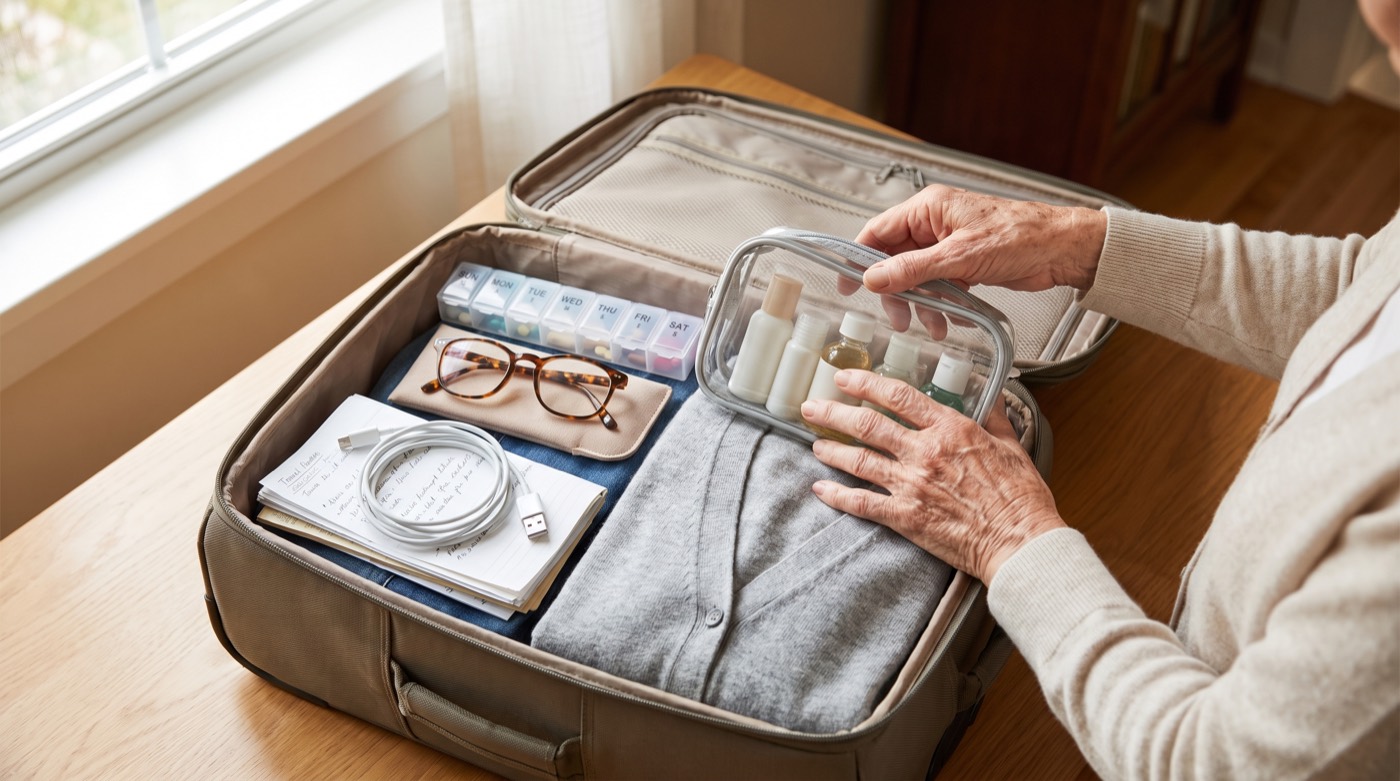
The short answer
Pack the carry-on around the first 24 hours, not the entire trip: documents, medication, glasses, devices, a change of clothes, comfort items and anything you cannot replace quickly. Then check the airline’s size/weight rules and TSA’s current liquid guidance.
Carry-on packing checklist for travelers over 60: pack the first 24 hours
A cabin bag should protect you from the most expensive kind of delay: being without the things that cannot be replaced quickly. Medication, glasses, documents, phone, charger, a layer and one change of clothes deserve priority. The goal is not to carry the whole trip in the cabin. It is to make your first day work even if a checked bag or a connection does not.
Build the list by function rather than by object: documents, health, comfort, electronics, one change of clothes, liquids and the things you need in the first hour after landing. Then check the packed bag against your airline's exact size and weight rule — TSA liquid rules and the airline's cabin allowance are related but separate questions.
- Anything you would struggle to replace goes in your carry-on, never in the hold.
- Pack in the order you will need things, with medication and documents on top.
- Keep liquids and electronics where you can reach them without unpacking everything.
- A spare warm layer belongs in the bag, not in the suitcase you checked.
What belongs in the bag that stays with you
A carry-on has one purpose: to hold everything that would ruin your trip if it went missing, plus everything you need during the journey itself. That is a shorter list than most people pack.
| Category | Pack first | Keep accessible |
|---|---|---|
| Documents | Passport/ID, itinerary, insurance and address | Small document pouch |
| Health | Medication, glasses, prescriptions and aids | Original packaging where appropriate |
| Comfort | Layer, water plan, snacks and neck support | Top pocket |
| Electronics | Phone, charger, hearing/battery items | Charged and labeled |
| Contingency | Underwear, shirt and essential toiletries | One compact spare set |
Pack around replacement difficulty
Place the most important items where you can reach them without unpacking. Keep medication and glasses on your person or in the cabin bag, not in checked luggage. If liquids are needed, use containers that fit the current security rule and keep them together for screening.
Do a trial pack and weigh the bag before you travel. A checklist that ignores how heavy the result is has missed the point, and so has one that keeps adding items until the case no longer fits the rule.
- Keep essential medication and documents out of checked luggage.
- Use offline copies of addresses, contacts and confirmations.
- Check liquids, batteries and mobility-device rules separately.
- Leave room for airport purchases or do not plan on it.
Packed in the order you will need it
The difference between an easy journey and an awkward one is usually the order of the packing, not the contents. Everything you will need in the first four hours should be reachable without opening the whole case.
Pack in layers, from the top down. The table shows the order that matches the sequence of a normal travel day.
| Layer | What goes here | When you will need it |
|---|---|---|
| Outside pocket | Boarding pass, ID, reading glasses | Repeatedly, from the front door onwards |
| Top of the bag | Medication, liquids bag, phone and charger | At security, and during the flight |
| Middle | Warm layer, book, snack, tissues | Once you are settled on board |
| Bottom | Change of clothes, chargers, spare glasses | Only if a checked bag goes missing |
| Never in here | Anything sharp, large liquids, prohibited items | It will be taken at security |
Your packing checklist, in order
Use this as a working checklist while you pack — it follows the same order as the table above.
- Write the first 24-hour risk list.
- Pack documents, medication, glasses and devices first.
- Add comfort, spare layer and one change of clothes.
- Check liquids, batteries and medical items against current rules.
- Measure and weigh the final bag.
- Place the checklist and emergency contacts where they are easy to reach.
Medication, documents and the things that must not go missing
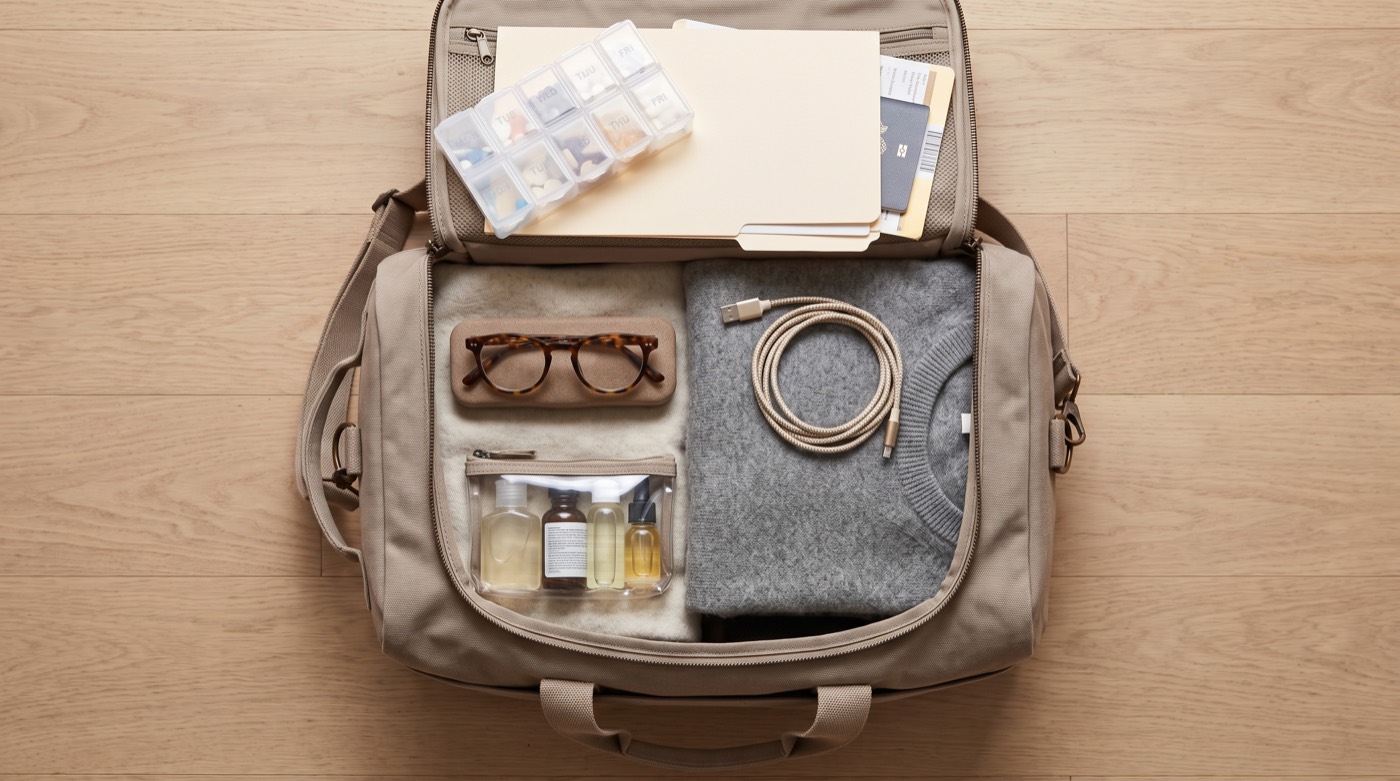
Keep medication in its original labelled packaging, carry a little more than the trip requires, and keep it in the cabin with you regardless of how long the flight is. Temperatures in the hold and delayed baggage are both real risks.
Do the same with documents. A photograph of your passport, insurance policy and prescriptions stored on your phone — and printed once on paper — costs nothing and solves a genuinely bad day.
- Carry medication in the cabin, in original packaging, with a few extra days' supply.
- Keep a written list of medications and dosages, in case you need care abroad.
- Photograph your passport, insurance and tickets; keep one printed copy separately.
- Never pack house keys, jewellery or spare glasses in a checked bag.
Watch this on our channel
The same subject, explained on screen — from our Over 60 Travel Secrets channel.
TSA WARNING: 7 'Normal' Items Banned in 2026 (Check Your Bag!)
More videos on the Over 60 Travel Secrets channel →
Questions people ask
What should go in a senior traveler’s carry-on first?
Medication, documents, glasses, phone, charger, a layer, essential toiletries and one change of clothes.
Can I pack all liquids in the cabin bag?
Check current TSA liquid guidance and the airline’s separate size/weight rule; keep necessary items accessible for screening.
Should medication go in checked luggage?
Essential medication should remain accessible in the cabin bag, with any required documentation handled appropriately.
How do I know if the bag is too heavy?
Do a trial pack, lift it safely and compare the final weight and dimensions with the exact airline allowance.
Sources & how we keep this current
Rules, fees and programs change. These are the official pages we check — go to them for the version that applies on your travel date.
Last reviewed: September 7, 2026. We re-check every guide quarterly and immediately after an official rule change.