The short answer
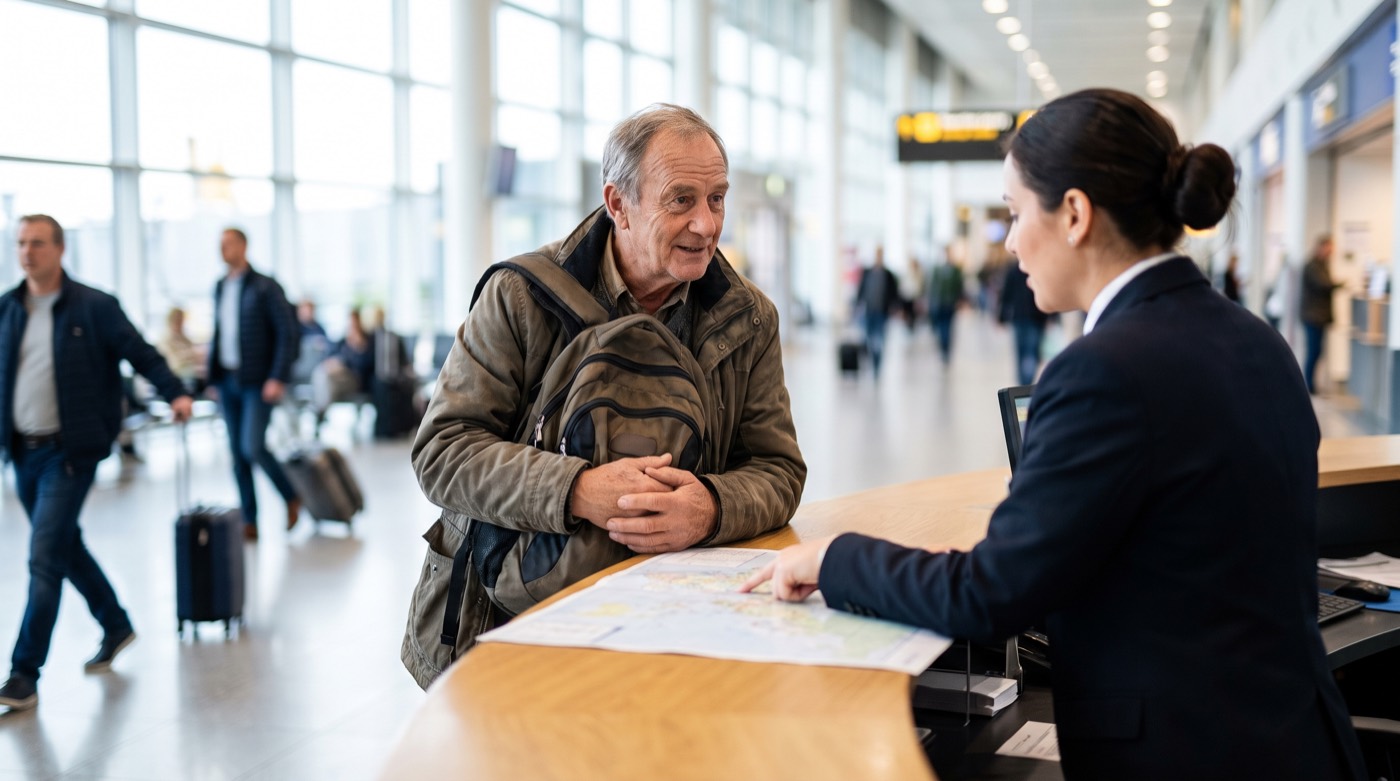
The best protection against airport scams is a pause-and-verify habit: keep your bag and valuables in front of you, use official desks, never hand your phone or card to someone who approached you, and ask uniformed staff for help. Slowing down defeats almost every one of these schemes.
Airport scams older travelers should know: pause, verify, continue
Airports are busy places where travelers are tired, distracted and carrying documents. A scam can be a fake helper asking to handle a phone, an unofficial transport offer, a payment request, or a stranger creating urgency around a bag. The answer is not fear or suspicion of everyone. It is a simple habit: pause, move to an official place and verify.
This is about tools, not fear. Know where official help is found, how to protect a card and a phone, what information you never need to hand over, and what to do afterwards if something feels wrong. Being older does not make you a target — being rushed and distracted does, and that is fixable.
- Nearly every airport scam begins with someone being unusually helpful.
- Official staff wear identification and stand at marked desks — they do not approach you.
- Slow down. Every one of these schemes depends on you feeling rushed.
- One calm sentence — “No thank you” — ends almost all of them.
How the common ones work
Airport scams are not clever; they are simply well practised. Each has a recognisable shape, and recognising the shape is enough to end it.
| Situation | Warning sign | Safer response |
|---|---|---|
| Unexpected help | Stranger wants phone, card or passport | Keep items and ask official staff |
| Transport | Pressure to pay or leave the terminal | Use the marked taxi/rideshare process |
| Payment | Urgent fee or card handover | Move to the official desk and verify |
| Device | Someone wants to install or unlock something | Refuse, lock the phone and seek staff |
| Luggage | Unclear request to carry or open a bag | Keep control and report concerns |
What to do when something feels wrong
You do not owe a stranger a quick answer. Say you will check with the airline or information desk, keep your passport and payment card, and move toward uniformed staff or a staffed counter. Keep your phone locked, carry a second payment method separately, and keep a short list of emergency contacts.
If something has already happened, tell airport security, your airline or the official transport desk. If a card or an account may be exposed, contact your bank through a number you look up yourself, never one you were given.
- Use official information desks, marked transport and known contacts.
- Keep the phone, card, passport and medication under your control.
- Do not let urgency replace verification.
- Report concerns early, even if no loss occurred.
Where each one tends to happen
Scams cluster at the points where travellers are most distracted: arriving, queueing, and leaving. Knowing which approach belongs to which part of the airport makes them much easier to spot.
None of this needs suspicion of everyone around you. It needs one habit: when a stranger initiates contact and there is money or your luggage involved, stop and check.
| Where | What it looks like | What to do |
|---|---|---|
| Arrivals hall | Someone offering a taxi before you reach the rank | Use the official rank or a pre-booked car |
| Security line | A stranger creating a delay while a second person takes a bag | Keep bags in front of you and in sight through the belt |
| Ticket desks | Someone “helping” you use a machine | Decline politely; ask staff at the desk instead |
| Currency exchange | Excellent rate advertised, large commission hidden | Ask for the exact amount you will receive, in writing |
| Cafés and gates | Free Wi-Fi network with a plausible name | Use your own data for anything involving a password |
| Kerbside | Unofficial porters who then demand a large fee | Agree a price first, or carry your own bag |
What to do if something happens
If something does go wrong, acting in this order limits the damage considerably.
- Pause before handing over a card, phone, passport or bag.
- Move to an official desk, gate agent or security point.
- Verify the request and the payment channel.
- Lock the device and contact the bank if details were exposed.
- Report the incident and note time/place for follow-up.
- Save trusted airport and airline contacts before the trip.

Being cautious without being unfriendly
None of this means treating strangers as threats. Airports are full of genuinely kind people, and most offers of help are exactly what they appear to be.
The habit worth keeping is narrower than general suspicion: when someone you did not approach wants your bag, your card, your phone or your documents, slow down and verify. That single rule covers nearly everything on this page, and it costs you nothing socially.
- Keep your bag strap over your shoulder and in front of you in queues.
- Carry one card you would not mind cancelling, and keep the other separately.
- Ask for help at a marked desk rather than accepting it from someone who approached you.
- If you are pressed for a decision, that pressure is the warning sign.
Watch this on our channel
The same subject, explained on screen — from our Over 60 Travel Secrets channel.
Don't Be a Victim: 15 Airport Scams Ruining Senior Trips in 2026
More videos on the Over 60 Travel Secrets channel →
Questions people ask
What is the safest response to a suspicious airport request?
Pause, keep control of your phone, card, passport and bag, and verify with official staff.
How can I identify official transport help?
Use marked pickup points, the airport’s official desk and the instructions in your booking; do not let urgency override verification.
What if someone handled my card or phone?
Lock the device, contact the bank or provider through a verified number and report the concern to airport or airline staff.
Are older travelers more likely to be scammed?
Not inherently. Busy airports make everyone vulnerable, and most schemes rely on you being rushed rather than on your age. A pause-and-verify habit protects anyone who uses it.
Sources & how we keep this current
Rules, fees and programs change. These are the official pages we check — go to them for the version that applies on your travel date.
- FTC Consumer Advice
- TSA — Special Procedures & Screening Assistance
- US DOT — Aviation Consumer Protection
Last reviewed: September 7, 2026. We re-check every guide quarterly and immediately after an official rule change.